
Unreal Speech
Cost-effective text-to-speech API with 300ms latency, 48 voices across 8 languages, and pricing up to 11x cheaper than competitors.
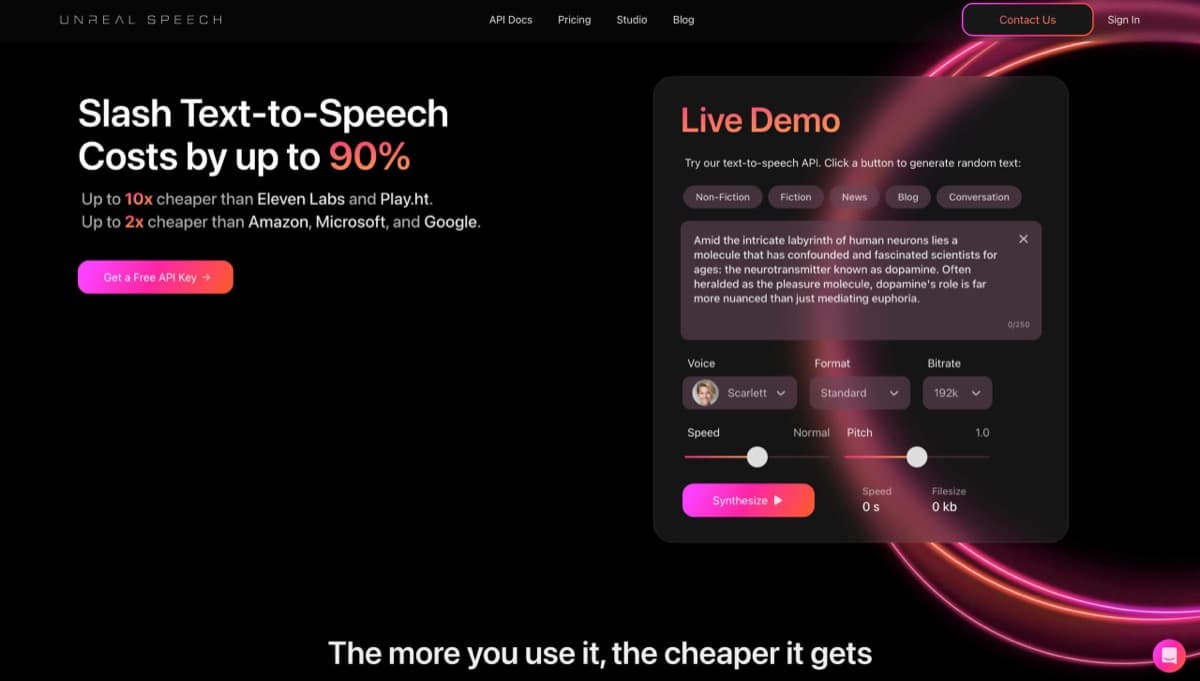
Unreal Speech is a text-to-speech API designed for developers and content creators who need natural-sounding voice generation without the premium price tag. The platform delivers ultra-low latency streaming at just 300ms, making it suitable for real-time applications and interactive use cases. With 48 realistic voices available across 8 languages, it offers solid linguistic coverage for global applications. The service handles up to 10 hours of audio generation per request and provides per-word timestamps for precise synchronization with video or subtitle workflows. What sets Unreal Speech apart is its aggressive pricing strategy — advertising costs up to 11 times lower than competitors like ElevenLabs — combined with a generous free tier that gives new users 250K characters to experiment with. The API includes customizable parameters for speed, pitch, and bitrate, allowing fine-tuning of output to match specific project requirements. For developers, the service offers code samples in Python, JavaScript, and other languages to streamline integration. Here's what you need to know before signing up.
Key Features
- Real-time Audio Streaming: Delivers audio with 300ms latency, enabling live applications, interactive voice responses, and responsive user experiences.
- 48 Voices Across 8 Languages: Provides diverse voice options covering major languages, suitable for multilingual content production and international applications.
- Per-word Timestamps: Generates precise timing data for each word, essential for video synchronization, subtitle alignment, and accessibility tools.
- Customizable Audio Parameters: Users can adjust speed, pitch, and bitrate to tailor output for specific use cases, from slow narrated content to fast-paced presentations.
- High-Volume Production Capacity: Supports up to 10 hours of audio generation per single request, handling large-scale voiceover projects efficiently.
- Developer-Friendly API: Includes comprehensive documentation with code samples in Python, JavaScript, and other languages for quick implementation.
- Volume-Based Pricing: Offers discounted rates for high-usage customers, making it economically viable for continuous production workloads.
- Generous Free Tier: Provides 250K free characters, allowing substantial testing and small-scale projects without initial investment.
Pricing & Plans
Unreal Speech operates on a freemium model with a free tier offering 250K characters, which is notably generous compared to many competitors that provide far less for testing. Paid plans use volume-based pricing with tiered discounts — the more you use, the lower the per-character cost. The platform advertises savings of up to 90-11x compared to premium providers like ElevenLabs, though exact pricing tiers require account creation to view. This pricing structure makes it particularly attractive for high-volume users such as podcast producers, audiobook creators, and businesses running large-scale voice applications. The free tier alone is sufficient for hobbyists or developers evaluating the technology, while production-scale users can access significant cost reductions through the volume discounts.
Pros & Cons
What works well:
- Exceptional cost efficiency — significantly cheaper than ElevenLabs and similar premium alternatives
- Ultra-fast 300ms streaming latency enables real-time and interactive use cases
- High-quality, natural-sounding voices across multiple languages
- Easy API integration with comprehensive documentation and code samples
- Very generous free tier (250K characters) for testing and small projects
- Handles high-volume production with up to 10 hours of audio per request
- Per-word timestamps enable precise synchronization workflows
- Customizable speed, pitch, and bitrate parameters provide flexibility
Where it falls short:
- No voice cloning capability, limiting personalization options
- Feature limitations on lower-tier plans may restrict advanced functionality
- Limited user reviews available for thorough third-party validation
- Voice quality consistency varies across different languages
- No detailed feature comparisons with alternatives provided on website
Who It's For
Unreal Speech targets a broad range of users, with developers being the primary audience. The API-first design and comprehensive documentation make it well-suited for software engineers building applications that require voice output. Content creators including YouTubers, podcasters, and audiobook producers will benefit from the cost efficiency for high-volume voiceover work. Businesses needing interactive voice responses, accessibility tools, or multilingual customer service applications can leverage the real-time streaming and timestamp features. The generous free tier also makes it accessible for hobbyists and small projects. However, users specifically seeking voice cloning or highly personalized voice options should look elsewhere, as this capability is not currently offered.
The Bottom Line
Unreal Speech delivers impressive value for cost-conscious users needing reliable text-to-speech at scale. The combination of ultra-low latency, generous free tier, and aggressive volume pricing makes it a compelling alternative to premium competitors. While the lack of voice cloning and occasional quality inconsistency across languages are notable limitations, the core offering is strong for developers and content producers prioritizing cost and scalability over advanced voice customization. Those building real-time voice applications or handling high-volume production will find particular value here, while users needing voice cloning should consider alternatives like ElevenLabs.