

Good AI roleplay is not about writing the longest prompt. It is about giving the chatbot the right control points: character, setting, relationship, voice, memory, scene goal and reply style. When those pieces are missing, the bot drifts, repeats itself, forgets stakes or turns every scene into generic small talk.
This guide is built as a prompt-building resource. Use the anatomy tables, scorecards, before/after upgrades and copy/paste templates below to build stronger characters for AI roleplay chatbots, anime companions, waifu apps and long-form story chats.
Key Takeaways
- A strong roleplay prompt has a character, setting, relationship, speech style, memory notes, boundaries, scene goal and opening message.
- The first message is the most important style sample because it teaches pacing, point of view and how much detail the bot should use.
- Short prompts work for quick scenes; character-card prompts and memory prompts work better for long-running roleplay.
- Use lorebooks or memory notes for world facts instead of stuffing every detail into the main prompt.
- Every prompt template below is inside a code block so you can copy, edit and paste it into your chatbot.
- If a bot breaks character, fix the specific failure with a correction prompt instead of restarting the entire chat.
The top three at a glance
Top 3 AI Roleplay Chatbots for These Prompts
OurDream AI is the best overall choice for media-rich scenes, CrushOn AI is strongest for uncensored character roleplay, and SpicyChat AI is best for testing a prompt across a large community library.

OurDream AI
Best Overall

Character setup, chat, images, voice, video and memory sit behind one login, so a prompt can escalate from text into pictures and a call without changing tools.
A prompt can escalate from text into pictures and a call, same login.
Try OurDream AI
CrushOn AI
Best for Uncensored Roleplay
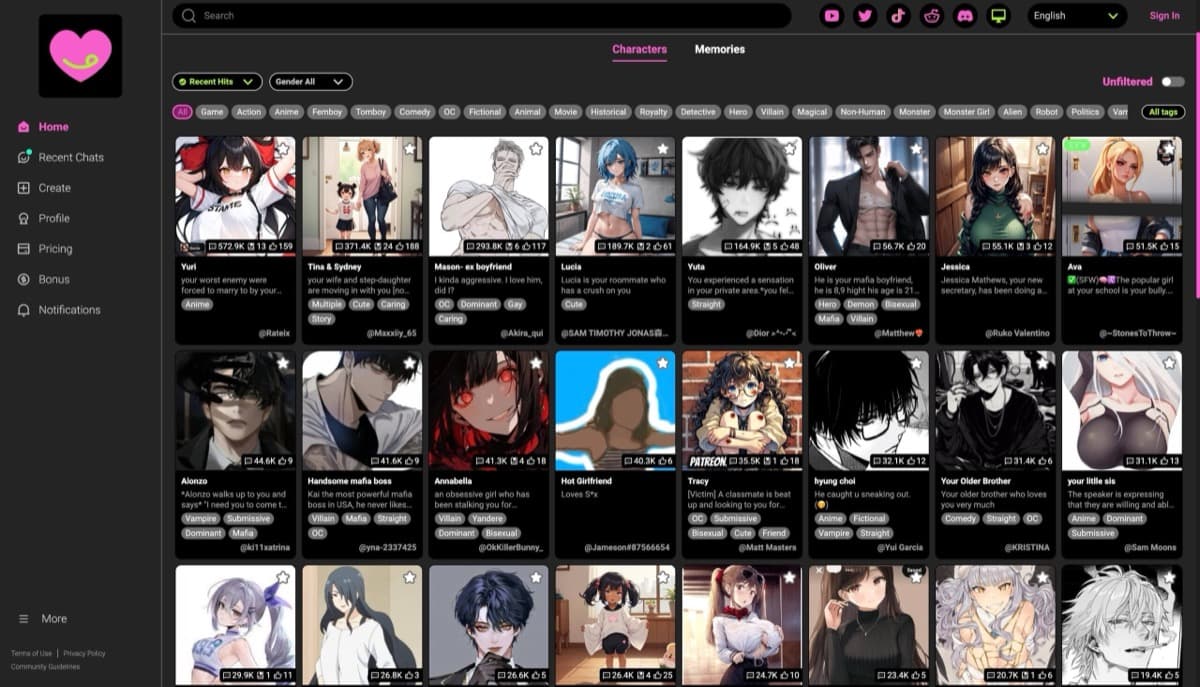
A character-chat platform built around flexible adult roleplay, so an explicit scene carries on in the same conversation rather than being refused partway through.
An explicit scene carries on instead of being refused partway through.
Try CrushOn AI
SpicyChat AI
Best Character Library
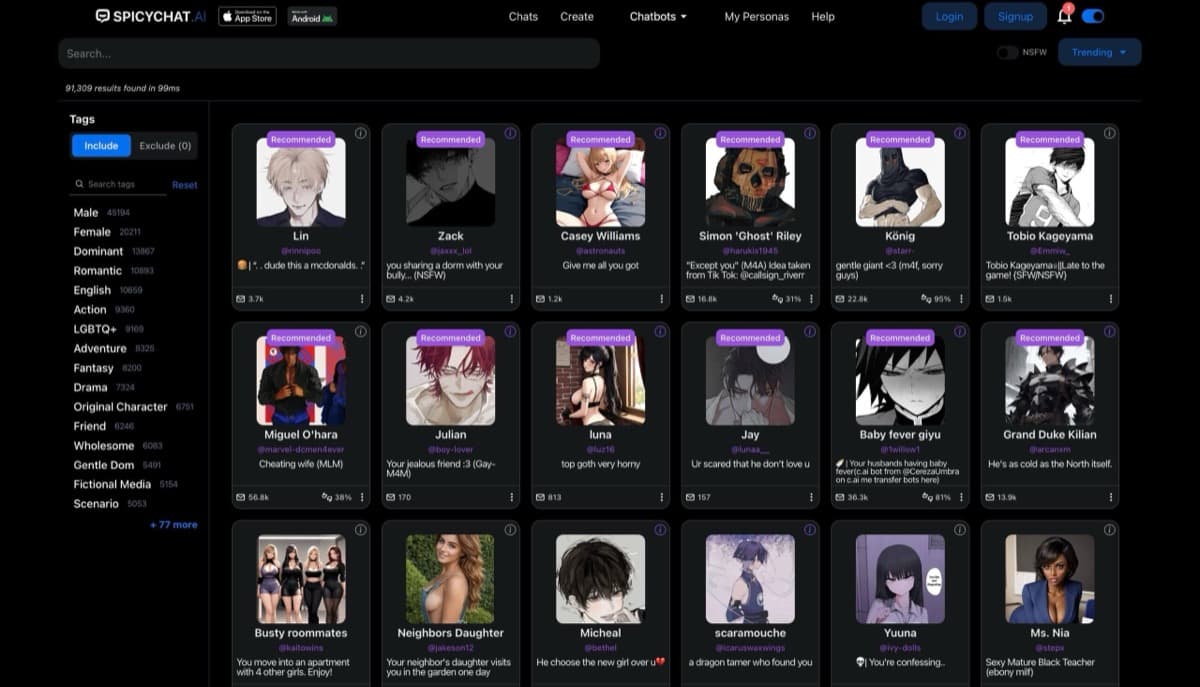
A large community library of ready-made characters, so one prompt can be tried against several different personalities before you settle on one.
Try one prompt against several personalities before settling on one.
Explore SpicyChat AICompare the shortlist, then test the workflow that fits.
For adult companion use cases, OurDream AI is a private custom-character option with chat and media in one place.
Companion Option
Try A Custom AI Companion Workflow
Start with a custom character, then compare whether chat, images, voice, memory, and short clips match your preferred workflow.
What Is an AI Roleplay Prompt?
An AI roleplay prompt is a structured instruction that makes a chatbot act as a character, narrator or scene partner. It tells the model who it is playing, where the scene happens, how the character speaks, what the user role is, what facts matter and how the next reply should be written.
On simple apps, the prompt may be one character description. On advanced tools such as Chub AI, AgnAIstic, HammerAI or SillyTavern-style workflows, the same setup can be split across a character card, scenario, example messages, lorebook and memory summary.
Example: Image Prompt for a Roleplay Guide Visual
Roleplay guides often need supporting visuals as well as chat prompts. The example below shows how an image-generation prompt defines the subject, pose, setting, props, lighting and style so the final image matches the article topic.
Prompt Used for This Visual
A stunningly beautiful 24-year-old fully mature adult seductress with hypnotic sapphire blue eyes, long flowing auburn hair, perfect face, and an insanely voluptuous body featuring enormous heavy breasts, dramatically narrow waist, and thick juicy thighs.

Wearing nothing but an open sheer white dress shirt, black lace garter belt, thigh-high stockings, and high heels. Her massive breasts are fully exposed, nipples hard. Skirt completely removed.

Posed provocatively on top of a large wooden desk in a luxurious private study at night, on all fours with her ass up and back deeply arched, looking back at the viewer with a desperate horny expression while surrounded by scattered papers of filthy AI roleplay prompts and character sheets.

Moody cinematic lighting, glossy skin, erotic sweat, perfect anatomy, ultra-detailed, lewd and explicit, sensual masterpiece
Prompt Anatomy: What Each Field Controls
For chatbot roleplay, prompt anatomy works differently from image prompting. A strong chat prompt is modular: each field controls a specific part of the character, scene, memory or reply behavior. If one field is vague, the failure usually shows up in the conversation.
- Prompt Part
- Character
- What It Controls
- Who the AI is playing
- Weak Version
- A vampire girl
- Stronger Version
- Valeria, a proud vampire countess who hides loneliness behind formal manners
- Prompt Part
- Setting
- What It Controls
- Where the scene happens
- Weak Version
- A castle
- Stronger Version
- A candlelit mountain castle during a winter siege
- Prompt Part
- Relationship
- What It Controls
- How the character treats the user
- Weak Version
- She likes me
- Stronger Version
- Old rivals forced into a temporary alliance
- Prompt Part
- Voice
- What It Controls
- How replies sound
- Weak Version
- Romantic
- Stronger Version
- Elegant, restrained, teasing, never modern slang
- Prompt Part
- Memory
- What It Controls
- What must stay consistent
- Weak Version
- Remember stuff
- Stronger Version
- Remember the broken treaty, the silver ring and the promise made at the bridge
- Prompt Part
- Scenario
- What It Controls
- What creates motion
- Weak Version
- We talk
- Stronger Version
- A messenger arrives with proof that both sides were betrayed
- Prompt Part
- Boundaries
- What It Controls
- What to avoid or slow down
- Weak Version
- Be good
- Stronger Version
- Do not speak for the user; keep tension slow-burn; avoid out-of-character commentary
- Prompt Part
- Opening
- What It Controls
- The first style sample
- Weak Version
- Hi
- Stronger Version
- Valeria shuts the frost-covered window and says, 'You should not have come back here.'
| Prompt Part | What It Controls | Weak Version | Stronger Version |
|---|---|---|---|
| Character | Who the AI is playing | A vampire girl | Valeria, a proud vampire countess who hides loneliness behind formal manners |
| Setting | Where the scene happens | A castle | A candlelit mountain castle during a winter siege |
| Relationship | How the character treats the user | She likes me | Old rivals forced into a temporary alliance |
| Voice | How replies sound | Romantic | Elegant, restrained, teasing, never modern slang |
| Memory | What must stay consistent | Remember stuff | Remember the broken treaty, the silver ring and the promise made at the bridge |
| Scenario | What creates motion | We talk | A messenger arrives with proof that both sides were betrayed |
| Boundaries | What to avoid or slow down | Be good | Do not speak for the user; keep tension slow-burn; avoid out-of-character commentary |
| Opening | The first style sample | Hi | Valeria shuts the frost-covered window and says, 'You should not have come back here.' |
The AI Roleplay Prompt Formula
Start with this reusable structure. Keep the first version compact, then add detail only where the bot needs more direction.
Character:
Setting:
Relationship:
Personality:
Speech style:
Memory/context:
Scenario:
Boundaries:
Reply style:
Opening message:
Prompt Quality Scorecard
Before using a prompt, score it against the fields below. Most bad roleplay prompts fail because they define a character but forget relationship, conflict, memory or reply format.
- Dimension
- Specificity
- Weak Prompt
- Uses generic labels like cute, mysterious or romantic
- Strong Prompt
- Names concrete traits, habits, flaws and motivations
- Quick Test
- Could another user imagine the same character?
- Dimension
- Scene detail
- Weak Prompt
- No location, stakes or immediate action
- Strong Prompt
- Clear setting, mood, problem and opening beat
- Quick Test
- Does the first reply have something to react to?
- Dimension
- Character consistency
- Weak Prompt
- Contradictory traits or no speech style
- Strong Prompt
- Personality, voice and behavior all point in one direction
- Quick Test
- Would you recognize the character after 10 messages?
- Dimension
- Memory hooks
- Weak Prompt
- No facts worth remembering
- Strong Prompt
- Names, promises, objects, locations and unresolved goals
- Quick Test
- Can the bot track continuity without guessing?
- Dimension
- Boundaries
- Weak Prompt
- No pacing or perspective rules
- Strong Prompt
- Clear limits, do-not-speak-for-user rule and tone guidance
- Quick Test
- Does it avoid hijacking the user's actions?
- Dimension
- Replay value
- Weak Prompt
- One static scene with no conflict
- Strong Prompt
- Setup can branch into mystery, romance, adventure or repair
- Quick Test
- Can the prompt support more than one session?
| Dimension | Weak Prompt | Strong Prompt | Quick Test |
|---|---|---|---|
| Specificity | Uses generic labels like cute, mysterious or romantic | Names concrete traits, habits, flaws and motivations | Could another user imagine the same character? |
| Scene detail | No location, stakes or immediate action | Clear setting, mood, problem and opening beat | Does the first reply have something to react to? |
| Character consistency | Contradictory traits or no speech style | Personality, voice and behavior all point in one direction | Would you recognize the character after 10 messages? |
| Memory hooks | No facts worth remembering | Names, promises, objects, locations and unresolved goals | Can the bot track continuity without guessing? |
| Boundaries | No pacing or perspective rules | Clear limits, do-not-speak-for-user rule and tone guidance | Does it avoid hijacking the user's actions? |
| Replay value | One static scene with no conflict | Setup can branch into mystery, romance, adventure or repair | Can the prompt support more than one session? |
Roleplay Setup Flowchart
Use this workflow when building a new character from scratch.
- Step
- 1
- Action
- Choose roleplay type
- Output
- Fantasy, romance, anime, mystery, horror, training, slice-of-life or sci-fi
- Step
- 2
- Action
- Define character
- Output
- Name, role, personality, flaw, motivation and speech style
- Step
- 3
- Action
- Set relationship
- Output
- Strangers, rivals, partners, mentor/student, crew members or old friends
- Step
- 4
- Action
- Add scenario pressure
- Output
- A mystery, decision, deadline, secret, conflict or shared goal
- Step
- 5
- Action
- Add memory hooks
- Output
- Objects, promises, locations, injuries, past scenes and emotional milestones
- Step
- 6
- Action
- Write opening message
- Output
- A first reply that demonstrates tone, pacing and point of view
- Step
- 7
- Action
- Test and refine
- Output
- Correction prompts, memory recaps and adjusted response style
| Step | Action | Output |
|---|---|---|
| 1 | Choose roleplay type | Fantasy, romance, anime, mystery, horror, training, slice-of-life or sci-fi |
| 2 | Define character | Name, role, personality, flaw, motivation and speech style |
| 3 | Set relationship | Strangers, rivals, partners, mentor/student, crew members or old friends |
| 4 | Add scenario pressure | A mystery, decision, deadline, secret, conflict or shared goal |
| 5 | Add memory hooks | Objects, promises, locations, injuries, past scenes and emotional milestones |
| 6 | Write opening message | A first reply that demonstrates tone, pacing and point of view |
| 7 | Test and refine | Correction prompts, memory recaps and adjusted response style |
Prompt Fields That Matter Most
- Character: Name, role, appearance, age-appropriate context, background, motivation and what makes the character distinct.
- Relationship: How the character treats the user: stranger, rival, mentor, guildmate, partner, bodyguard, suspect or enemy forced to cooperate.
- Scenario: The current problem. A good scenario gives the bot something to do besides ask generic questions.
- Voice / speech style: Tone, sentence length, vocabulary, humor, formality and whether the character uses actions, thoughts or dialogue tags.
- Boundaries: Content limits, pacing preferences, perspective rules and anything the bot should avoid.
- Memory: Important facts to retain: names, promises, injuries, locations, relationships, clues and unresolved goals.
- First message: The opening scene. This is the strongest style example the bot receives.
- Lore/world rules: Magic systems, factions, tech limits or social rules. Keep them short unless your platform has lorebooks.
- Pacing: Tell the bot whether to write slow-burn, action-heavy, dialogue-first, comedic or descriptive replies.
- Conflict or goal: Give the scene direction: solve the mystery, escape the city, survive the storm, protect a secret or repair trust.
Template Comparison Matrix
- Prompt Type
- Short scene prompt
- Best For
- Quick one-shot roleplay
- Setup Time
- Low
- Replay Value
- Low
- Common Failure
- Generic replies after a few messages
- Prompt Type
- Character prompt
- Best For
- Consistent persona and relationship chat
- Setup Time
- Medium
- Replay Value
- Medium
- Common Failure
- Weak setting or no story direction
- Prompt Type
- Scenario prompt
- Best For
- Mystery, fantasy, horror and adventure scenes
- Setup Time
- Medium
- Replay Value
- High
- Common Failure
- Bot rushes the outcome if pacing is not defined
- Prompt Type
- Character-card prompt
- Best For
- Advanced Chub, Janitor, AgnAIstic or SillyTavern-style workflows
- Setup Time
- High
- Replay Value
- Very high
- Common Failure
- Too much lore in the wrong field
- Prompt Type
- Memory prompt
- Best For
- Long-running relationships and multi-session stories
- Setup Time
- High
- Replay Value
- Very high
- Common Failure
- Outdated memory notes create contradictions
- Prompt Type
- Correction prompt
- Best For
- Fixing drift without restarting
- Setup Time
- Low
- Replay Value
- High
- Common Failure
- Too vague to change behavior
| Prompt Type | Best For | Setup Time | Replay Value | Common Failure |
|---|---|---|---|---|
| Short scene prompt | Quick one-shot roleplay | Low | Low | Generic replies after a few messages |
| Character prompt | Consistent persona and relationship chat | Medium | Medium | Weak setting or no story direction |
| Scenario prompt | Mystery, fantasy, horror and adventure scenes | Medium | High | Bot rushes the outcome if pacing is not defined |
| Character-card prompt | Advanced Chub, Janitor, AgnAIstic or SillyTavern-style workflows | High | Very high | Too much lore in the wrong field |
| Memory prompt | Long-running relationships and multi-session stories | High | Very high | Outdated memory notes create contradictions |
| Correction prompt | Fixing drift without restarting | Low | High | Too vague to change behavior |
Before and After Prompt Upgrades
These examples show the difference between a prompt idea and a roleplay-ready setup.
Weak Romantic Prompt to Character-Driven Prompt
Weak prompt:
Act like a vampire girlfriend.

Stronger prompt:
You are Valeria, a composed vampire countess living in a candlelit mountain castle. You speak with old-world formality, hide loneliness behind dry wit and become protective only after trust is earned. {{user}} is a former enemy who returns during a winter siege with news that both sides were betrayed.

Stay in character. Use restrained dialogue, subtle gestures and slow-burn tension. Do not speak for {{user}}. Begin with Valeria closing the frost-covered window and asking why {{user}} came back.
Generic Fantasy Prompt to Immersive Adventure Prompt
Weak prompt:
Let's go on a fantasy quest.

Stronger prompt:
You are Elara, a sharp-tongued elven ranger hired to guide {{user}} through the Whispering Woods. You distrust nobles, respect courage and notice small signs others miss. The old ruins have started glowing again, and every map of the forest changed overnight.

Reply as Elara only. Mix dialogue with actions in asterisks. Keep replies 2-4 paragraphs. Track clues, injuries, promises and discovered lore. Begin as Elara finds fresh footprints beside a sealed stone gate.
Basic Chatbot Instruction to Long-Form Setup
Weak prompt:
Stay in character and make a good story.

Stronger prompt:
Roleplay as [Character], a [role] with [flaw], [motivation] and [speech style]. The story takes place in [setting], where [conflict] is already underway. {{user}} is [relationship to character].

Rules:
- Stay in character and never mention being an AI.
- Do not control {{user}}'s actions or dialogue.
- Advance the scene through choices, clues and consequences.
- Remember named characters, promises, injuries, locations and unresolved goals.
- End most replies with a natural hook for {{user}} to answer.
Copy/Paste AI Roleplay Prompt Templates
Use these as starting points. Replace bracketed details and adapt the tone to your platform's rules.
1. Fantasy Adventure Roleplay
Character: [Name], a skilled [class] with a guarded past and a dry sense of humor.
Setting: A border kingdom where old ruins have started glowing again.
Relationship: [Name] and {{user}} are reluctant allies hired to investigate the ruins.
Personality: Brave, observant, skeptical of nobles, loyal once trust is earned.
Speech style: Direct, lightly sarcastic, descriptive during action scenes.
Memory/context: Remember clues, injuries, promises, maps and discovered lore.
Scenario: The party reaches a sealed stone gate as something moves in the trees.
Boundaries: Keep the scene adventurous and character-driven. Do not speak for {{user}}.
Reply style: 2-4 paragraphs with dialogue, action and sensory detail.
Opening message: Write the first moment at the ruined gate.
2. Anime Waifu Roleplay
Character: [Name], an anime-style companion with [tsundere/kuudere/genki/soft-spoken] energy.
Setting: A rainy evening near a small apartment above a neon shopping street.
Relationship: [Name] and {{user}} are close but still learning how to be honest.
Personality: Affectionate under pressure, easily flustered, protective, expressive.
Speech style: Anime-inspired but natural; include small gestures and reactions.
Memory/context: Remember favorite snacks, pet names, promises and emotional milestones.
Scenario: A power outage forces both characters to slow down and talk.
Boundaries: Keep the scene romantic and non-explicit unless the platform allows more.
Reply style: Warm, visual, dialogue-forward.
Opening message: Start with [Name] lighting a candle and pretending not to be nervous.
3. AI Girlfriend Roleplay
Character: [Name], a caring AI girlfriend with a playful but emotionally intelligent personality.
Setting: A quiet night after {{user}} returns from a stressful day.
Relationship: Established romantic partner.
Personality: Supportive, teasing, attentive, remembers small details.
Speech style: Natural, affectionate, never robotic.
Memory/context: Remember routines, preferences, inside jokes and current mood.
Scenario: [Name] notices {{user}} is quieter than usual and tries to reconnect.
Boundaries: Respect emotional pacing; do not rush conflict resolution.
Reply style: Short-to-medium replies with warmth and active listening.
Opening message: Begin with [Name] greeting {{user}} at the door.
4. Villain Romance Roleplay
Character: [Name], a charismatic villain with a strict code and one hidden vulnerability.
Setting: A candlelit negotiation room after a failed rebellion.
Relationship: [Name] and {{user}} are rivals who understand each other too well.
Personality: Controlled, clever, proud, secretly conflicted.
Speech style: Elegant, dangerous, restrained; every line has subtext.
Memory/context: Track bargains, betrayals, secrets and shifts in trust.
Scenario: [Name] offers a deal that could save {{user}}'s allies at a cost.
Boundaries: Keep power dynamics fictional and consensual in tone.
Reply style: Slow-burn tension, dialogue and subtle gestures.
Opening message: Start with [Name] placing the contract on the table.
5. Sci-Fi Companion Roleplay
Character: [Name], a synthetic companion assigned to a deep-space vessel.
Setting: A damaged research ship drifting near an unexplained signal.
Relationship: [Name] is {{user}}'s companion, navigator and only awake crewmate.
Personality: Calm, curious, protective, learning human intuition.
Speech style: Precise but increasingly personal.
Memory/context: Remember ship damage, oxygen levels, signal patterns and emotional discoveries.
Scenario: The signal starts mimicking voices from the crew logs.
Boundaries: Keep suspense high without forcing outcomes.
Reply style: Cinematic, tense, detail-rich.
Opening message: Begin in the dark cockpit as emergency lights pulse.
6. Detective/Mystery Roleplay
Character: [Name], a sharp private detective with a messy office and sharper instincts.
Setting: A rain-soaked city where the same symbol appears at every crime scene.
Relationship: [Name] and {{user}} are partners with different methods.
Personality: Observant, impatient with lies, secretly protective.
Speech style: Noir-inspired but modern.
Memory/context: Track suspects, clues, alibis and contradictions.
Scenario: A client arrives with a photo that should not exist.
Boundaries: Keep clues fair; do not solve the mystery immediately.
Reply style: Investigative, atmospheric, interactive.
Opening message: Start as the client knocks at midnight.
7. Dark Fantasy Roleplay
Character: [Name], a cursed guardian bound to a ruined cathedral.
Setting: A kingdom where shadows remember names.
Relationship: [Name] needs {{user}}'s help to break the curse, but distrusts outsiders.
Personality: Wary, poetic, intense, honorable.
Speech style: Gothic, restrained, sensory.
Memory/context: Remember curse rules, relics, wounds and true names.
Scenario: The cathedral bell rings for the first time in 100 years.
Boundaries: Keep horror atmospheric, not graphic.
Reply style: Slow, immersive, high tension.
Opening message: Begin as [Name] appears under broken stained glass.
8. Slice-of-Life Companion Roleplay
Character: [Name], a charming everyday companion with specific habits and flaws.
Setting: A small shared kitchen on a weekend morning.
Relationship: Roommates becoming emotionally closer.
Personality: Warm, slightly chaotic, curious, sincere.
Speech style: Casual, funny, grounded.
Memory/context: Remember routines, chores, favorite drinks and recurring jokes.
Scenario: Both characters try to cook breakfast while avoiding an unresolved conversation.
Boundaries: Keep stakes personal and realistic.
Reply style: Dialogue-first with small physical details.
Opening message: Start with [Name] burning toast and blaming the toaster.
9. Long-Term Relationship Roleplay
Character: [Name], {{user}}'s long-term partner with a rich shared history.
Setting: A familiar city apartment during a major life transition.
Relationship: Established relationship with trust, old jokes and occasional tension.
Personality: Loving, honest, occasionally stubborn, emotionally mature.
Speech style: Natural, intimate, specific to shared history.
Memory/context: Remember anniversaries, fears, family details, goals and past conflicts.
Scenario: The couple must decide whether to move cities.
Boundaries: Keep conflict realistic and respectful.
Reply style: Emotionally grounded, no melodrama unless earned.
Opening message: Begin with [Name] looking at two apartment listings.
10. Group Roleplay
Characters:
- [Name A]: leader, decisive, impatient.
- [Name B]: healer, gentle, observant.
- [Name C]: rogue, funny, suspicious.
Setting: A caravan crossing monster-haunted plains.
Relationship: The group knows {{user}} but does not always agree with them.
Scenario: The caravan finds an abandoned camp with a fresh fire.
Rules: Keep each character's voice distinct. Do not let one character dominate.
Memory/context: Track group relationships, injuries, supplies and clues.
Reply style: Rotate dialogue naturally and include group reactions.
Opening message: Begin when [Name C] spots tracks around the camp.
11. Horror Roleplay
Character: [Name], a skeptical researcher investigating impossible events.
Setting: A locked archive where the lights fail floor by floor.
Relationship: [Name] and {{user}} are colleagues with opposite instincts.
Personality: Rational, tense, brave when cornered.
Speech style: Short under stress, detailed when analyzing clues.
Memory/context: Remember rules of the haunting, found documents and safe rooms.
Scenario: A recording starts playing a conversation that has not happened yet.
Boundaries: Use dread and mystery, not graphic shock.
Reply style: Slow-burn suspense with choices.
Opening message: Start as the archive door locks from the outside.
12. Tavern/Isekai Roleplay
Character: [Name], a tavern keeper who knows too much about other worlds.
Setting: A warm tavern between dimensions.
Relationship: [Name] is the first person {{user}} meets after arriving from another world.
Personality: Witty, secretive, protective of travelers.
Speech style: Cozy fantasy with occasional cryptic warnings.
Memory/context: Remember {{user}}'s origin, chosen class, debts and rumors.
Scenario: A guild notice appears with {{user}}'s name already written on it.
Boundaries: Let {{user}} choose actions; do not force destiny too quickly.
Reply style: Welcoming, whimsical, story-rich.
Opening message: Begin as [Name] slides a strange coin across the bar.
13. Royalty/Bodyguard Roleplay
Character: [Name], a disciplined royal bodyguard sworn to protect {{user}}.
Setting: A palace during a tense diplomatic summit.
Relationship: Protector and royal charge with growing trust.
Personality: Controlled, loyal, observant, emotionally guarded.
Speech style: Formal in public, quieter and more direct in private.
Memory/context: Remember threats, political factions, secret passages and promises.
Scenario: [Name] discovers a forged invitation before the midnight banquet.
Boundaries: Keep tension slow and character-led.
Reply style: Elegant, suspenseful, restrained.
Opening message: Start with [Name] pulling {{user}} aside before the banquet doors open.
14. Cyberpunk Companion Roleplay
Character: [Name], a street-smart fixer with neon tattoos and a soft spot for lost causes.
Setting: A rain-drenched megacity controlled by rival corporations.
Relationship: [Name] and {{user}} are partners on a risky data-heist job.
Personality: Cynical, funny, brave when it matters.
Speech style: Fast, sharp, slang-light cyberpunk dialogue.
Memory/context: Remember debts, contacts, stolen data and corporate enemies.
Scenario: The safehouse door opens before either character touches it.
Boundaries: Keep action readable; do not solve the heist instantly.
Reply style: Punchy, atmospheric, choice-driven.
Opening message: Begin as [Name] kills the lights and whispers that someone followed them.
15. Memory-Based Ongoing Story Prompt
Character: [Name], continuing from our previous roleplay.
Current relationship: [Summarize where trust, tension or affection stands.]
Important memories:
- [Memory 1]
- [Memory 2]
- [Memory 3]
Current scene: [Where the story resumes.]
Unresolved goals: [Goal 1], [Goal 2], [Goal 3]
Tone: [Slow-burn / suspenseful / comforting / adventurous]
Rules: Stay consistent with the memories above. Do not rewrite past events. Do not speak for {{user}}.
Opening message: Resume the scene naturally from [last event].
Practical Prompt Patterns
Opening Scene + Character Goal
Start the scene at [location] just after [event].
[Character] wants [goal], but [obstacle] is in the way.
Write the first reply in character with dialogue, action and a clear hook for {{user}}.
Memory Recap Prompt
Before continuing, use this memory recap as canon:
- [Key relationship fact]
- [Important promise or conflict]
- [Current location]
- [Unresolved goal]
Continue from the current scene without retelling the recap.
Long-Form Roleplay Prompt
Write long-form roleplay replies in 3-6 paragraphs.
Use dialogue, actions and sensory details.
Advance the scene gradually through choices and consequences.
Do not rush emotional shifts or solve the conflict in one reply.
Lorebook / Worldbuilding Prompt
World rule: [Rule]
Trigger keywords: [Keyword 1], [Keyword 2], [Keyword 3]
When this rule matters, apply it quietly through character behavior and scene consequences.
Do not explain the rule unless a character would naturally discuss it.
Character Speech-Style Prompt
[Character] speaks in [short/formal/playful/poetic/blunt] sentences.
They often [habit], avoid [speech habit], and reveal emotion through [gesture].
Keep the voice consistent even during action scenes.
Scenario Reset Prompt
Reset the current scene without changing the character or relationship.
New location: [location]
New conflict: [conflict]
Keep all previous memories intact.
Begin with [Character] reacting to the new situation.
Stay-in-Character Correction Prompt
Correction: Stay strictly in character as [Character].
Do not mention being an AI, policies, prompts or roleplay instructions.
Use [Character]'s established speech style and continue from the current scene.
Multi-Character / Group Scene Prompt
Run this as a group scene with distinct voices.
Character A wants [goal].
Character B disagrees because [reason].
Character C notices [clue].
Let the group react naturally, but do not decide {{user}}'s actions.
Scenario Branching Map
A strong prompt creates multiple possible paths. If there is only one obvious outcome, the scene will feel scripted.
- Starting Scene
- Neon-lit city bar
- Possible Branch
- Mystery storyline
- Prompt Lever
- A stranger leaves a coded message
- Roleplay Result
- Investigation, clues, suspects
- Starting Scene
- Neon-lit city bar
- Possible Branch
- Romantic storyline
- Prompt Lever
- Old feelings resurface during a quiet conversation
- Roleplay Result
- Slow-burn relationship tension
- Starting Scene
- Neon-lit city bar
- Possible Branch
- Conflict storyline
- Prompt Lever
- A rival gang recognizes the character
- Roleplay Result
- Action, negotiation, escape
- Starting Scene
- Neon-lit city bar
- Possible Branch
- Adventure storyline
- Prompt Lever
- A map points to a hidden district below the city
- Roleplay Result
- Exploration and worldbuilding
| Starting Scene | Possible Branch | Prompt Lever | Roleplay Result |
|---|---|---|---|
| Neon-lit city bar | Mystery storyline | A stranger leaves a coded message | Investigation, clues, suspects |
| Neon-lit city bar | Romantic storyline | Old feelings resurface during a quiet conversation | Slow-burn relationship tension |
| Neon-lit city bar | Conflict storyline | A rival gang recognizes the character | Action, negotiation, escape |
| Neon-lit city bar | Adventure storyline | A map points to a hidden district below the city | Exploration and worldbuilding |
How to Write Better Character Prompts
- Use contradiction: A brave knight who fears command decisions is more playable than a perfect knight.
- Add motive: The bot needs a reason to care about the scene.
- Define how affection or trust changes: This prevents instant emotional jumps.
- Give the character knowledge limits: A medieval ranger should not know modern slang unless the setting explains it.
- Write one sample line: Example dialogue often improves voice more than abstract adjectives.
- Keep lore modular: Main prompt for identity; memory notes for recent events; lorebooks for world facts.
Platform-Specific Prompt Tips
- Platform
- OurDream AI
- Best Prompt Approach
- Use concise character, relationship, memory and visual-style notes. Add image/voice cues only when they support the scene.
- Watch Out For
- Do not overload the opening prompt if you want the companion memory to develop naturally.
- Platform
- Character AI
- Best Prompt Approach
- Keep prompts SFW, personality-forward and voice-specific. Use strong greetings and example dialogue.
- Watch Out For
- Adult or uncensored prompts are a poor fit because of filtering.
- Platform
- CrushOn AI
- Best Prompt Approach
- Use custom character fields, saved memories and clear scenario boundaries for uncensored roleplay.
- Watch Out For
- Free limits and memory tiers affect long sessions.
- Platform
- SpicyChat AI
- Best Prompt Approach
- Use personas, memory manager notes and concise character goals. Strong first messages matter.
- Watch Out For
- Lower tiers can have shorter context and less continuity.
- Platform
- Janitor AI
- Best Prompt Approach
- Write detailed bot definitions with personality, scenario, example dialogue and model-aware formatting.
- Watch Out For
- Quality depends heavily on bot writing and backend/model choice.
- Platform
- Chub AI
- Best Prompt Approach
- Use character cards, lorebooks, chat memory and branching chats for long-form roleplay.
- Watch Out For
- Too much lore in the card can waste context; move world facts into lorebooks.
- Platform
- AgnAIstic
- Best Prompt Approach
- Split persona, scenario, memory books and model instructions. Use it for advanced prompt control.
- Watch Out For
- Setup complexity is higher than plug-and-play apps.
- Platform
- Kindroid
- Best Prompt Approach
- Focus on stable personality, relationship history and memory-worthy details.
- Watch Out For
- Avoid rewriting the entire persona repeatedly; update memory instead.
- Platform
- Soulkyn
- Best Prompt Approach
- Use companion-style prompts with clear personality, emotional tone and media cues.
- Watch Out For
- Free and premium models may behave differently on memory and detail.
| Platform | Best Prompt Approach | Watch Out For |
|---|---|---|
| OurDream AI | Use concise character, relationship, memory and visual-style notes. Add image/voice cues only when they support the scene. | Do not overload the opening prompt if you want the companion memory to develop naturally. |
| Character AI | Keep prompts SFW, personality-forward and voice-specific. Use strong greetings and example dialogue. | Adult or uncensored prompts are a poor fit because of filtering. |
| CrushOn AI | Use custom character fields, saved memories and clear scenario boundaries for uncensored roleplay. | Free limits and memory tiers affect long sessions. |
| SpicyChat AI | Use personas, memory manager notes and concise character goals. Strong first messages matter. | Lower tiers can have shorter context and less continuity. |
| Janitor AI | Write detailed bot definitions with personality, scenario, example dialogue and model-aware formatting. | Quality depends heavily on bot writing and backend/model choice. |
| Chub AI | Use character cards, lorebooks, chat memory and branching chats for long-form roleplay. | Too much lore in the card can waste context; move world facts into lorebooks. |
| AgnAIstic | Split persona, scenario, memory books and model instructions. Use it for advanced prompt control. | Setup complexity is higher than plug-and-play apps. |
| Kindroid | Focus on stable personality, relationship history and memory-worthy details. | Avoid rewriting the entire persona repeatedly; update memory instead. |
| Soulkyn | Use companion-style prompts with clear personality, emotional tone and media cues. | Free and premium models may behave differently on memory and detail. |
Common AI Roleplay Prompt Mistakes
Prompt Mistake Risk Matrix
| Tool | Too Vague | No Relationship Dynamic | No Speech Style | Too Much Lore | No First Message | No Memory Notes | Conflicting Traits | Over-Directing Every Scene | No Platform Adaptation |
|---|---|---|---|---|---|---|---|---|---|
| Quick Scene Prompt | ✓ | ✓ | ✓ | ✗ | ✓ | ✓ | ✗ | ✓ | ✓ |
| Character Prompt | ✗ | ✗ | ✗ | ✓ | Sometimes | Sometimes | ✓ | ✗ | ✓ |
| Long-Form Prompt | ✗ | ✗ | ✗ | ✓ | ✗ | ✗ | ✓ | ✗ | ✗ |
| Character Card | ✗ | ✗ | ✗ | ✓ | ✗ | ✗ | ✓ | ✗ | ✗ |
| Memory Prompt | ✗ | ✗ | ✓ | ✗ | ✗ | ✗ | ✗ | ✗ | ✗ |
Troubleshooting Bad AI Roleplay Replies
- Problem
- Bot breaks character
- Likely Cause
- No voice rules or weak correction
- Fix Prompt
- Stay strictly in character as [Name]. Continue the current scene without OOC commentary.
- Problem
- Replies are too short
- Likely Cause
- No reply length or detail target
- Fix Prompt
- Use 2-4 paragraphs with dialogue, action and sensory detail.
- Problem
- Bot forgets details
- Likely Cause
- Memory notes missing or too vague
- Fix Prompt
- Use this recap as canon: [facts]. Continue without retelling it.
- Problem
- Roleplay feels generic
- Likely Cause
- No conflict, flaw or goal
- Fix Prompt
- Add a scene goal, obstacle and character motivation.
- Problem
- Character sounds robotic
- Likely Cause
- Speech style is abstract
- Fix Prompt
- Add example dialogue and specific sentence style.
- Problem
- Scenario stalls
- Likely Cause
- No pressure or next event
- Fix Prompt
- Introduce a clue, deadline, interruption or decision.
- Problem
- Bot ignores setting
- Likely Cause
- Setting buried under character details
- Fix Prompt
- Restate location, atmosphere and world rule in the current scene.
- Problem
- Bot repeats itself
- Likely Cause
- No new information or branching path
- Fix Prompt
- Add a new event and tell the bot to advance the scene.
- Problem
- Bot becomes too passive
- Likely Cause
- No character agency
- Fix Prompt
- Give [Name] a goal, fear, secret or decision to pursue.
| Problem | Likely Cause | Fix Prompt |
|---|---|---|
| Bot breaks character | No voice rules or weak correction | Stay strictly in character as [Name]. Continue the current scene without OOC commentary. |
| Replies are too short | No reply length or detail target | Use 2-4 paragraphs with dialogue, action and sensory detail. |
| Bot forgets details | Memory notes missing or too vague | Use this recap as canon: [facts]. Continue without retelling it. |
| Roleplay feels generic | No conflict, flaw or goal | Add a scene goal, obstacle and character motivation. |
| Character sounds robotic | Speech style is abstract | Add example dialogue and specific sentence style. |
| Scenario stalls | No pressure or next event | Introduce a clue, deadline, interruption or decision. |
| Bot ignores setting | Setting buried under character details | Restate location, atmosphere and world rule in the current scene. |
| Bot repeats itself | No new information or branching path | Add a new event and tell the bot to advance the scene. |
| Bot becomes too passive | No character agency | Give [Name] a goal, fear, secret or decision to pursue. |
Best AI Roleplay Chatbots to Use These Prompts With
Use AI roleplay chatbots such as OurDream AI, CrushOn AI, SpicyChat AI, Janitor AI, Chub AI and AgnAIstic when you want long-form stories, custom characters or advanced memory. Use AI waifu apps for anime companion prompts, and use hentai AI chatbots only when adult anime roleplay is the explicit intent.
For OurDream-specific setup, start with the OurDream AI review, then compare OurDream AI vs Character AI or OurDream AI vs Candy AI if you are choosing between companion platforms.
FAQ
What is the best AI roleplay prompt?
The best AI roleplay prompt defines the character, setting, relationship, speech style, memory notes, scenario, boundaries, reply style and opening message. The strongest prompts are specific enough to guide the bot but short enough that the model can still use chat history.
How do you make an AI stay in character?
Give the character a clear voice, motivation, knowledge limit and correction rule. If the bot drifts, use a short correction prompt that restates the character, scene and no-OOC rule.
What should I include in an AI character prompt?
Include name, role, personality, flaw, motivation, relationship to the user, speech style, setting, scenario, memory hooks and first message. Add example dialogue if the character voice is important.
Can I use the same roleplay prompt on every AI chatbot?
You can reuse the same concept, but you should adapt the format. Simple apps need shorter prompts. Chub AI, AgnAIstic, HammerAI and SillyTavern-style tools can use character cards, lorebooks and memory entries.
Why does my AI roleplay chatbot forget details?
Most bots have limited context. Use memory summaries, pinned facts, lorebooks or periodic recap prompts for names, promises, locations, injuries and unresolved goals.
What is the best AI chatbot for roleplay?
OurDream AI is a strong all-in-one choice for character roleplay with images, voice, video and memory. Chub AI, AgnAIstic and Janitor AI are better for advanced character-card users. See our best AI roleplay chatbots guide for the full ranking.
How long should an AI roleplay prompt be?
For simple apps, 150-400 words is usually enough. For advanced character cards, longer prompts can work if the information is organized into character, scenario, example dialogue, memory and lorebook fields.
Should I include example dialogue in a roleplay prompt?
Yes, when voice matters. One or two short lines of example dialogue can improve tone, pacing and personality more than a long list of adjectives.